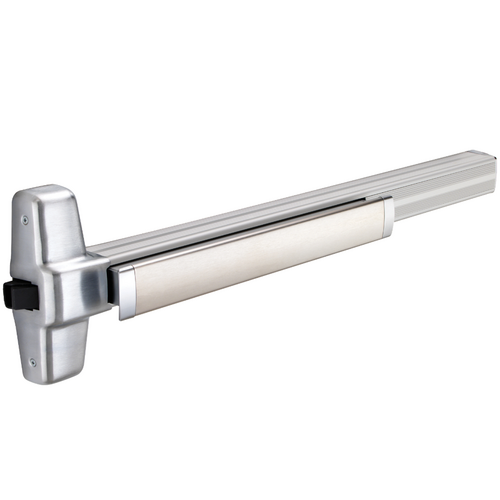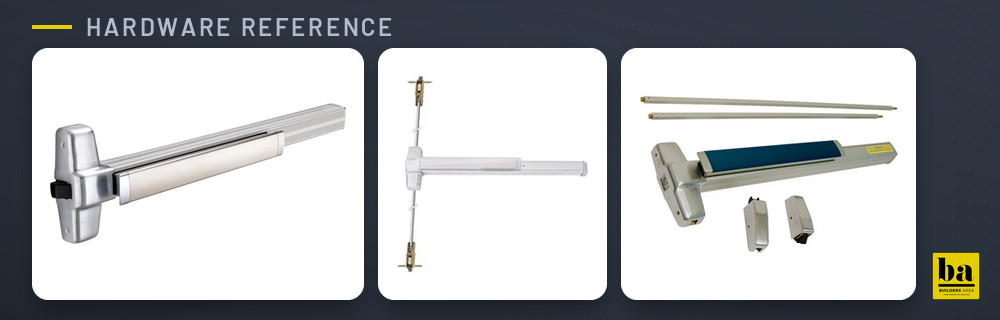
This page explains four exit device types - rim, surface vertical rod (SVR), concealed vertical rod (CVR) and mortise: where each one latches, how Von Duprin, Sargent and Corbin Russwin number them, and what to specify when you order.
Exit device types at a glance
| Type | Latches | Strikes |
|---|---|---|
| Rim | At one point | Surface-mounted strike as standard; for a pair of rim devices, a mullion |
| Surface vertical rod | Top and bottom | Top strike on the frame, bottom strike on the floor or threshold |
| Concealed vertical rod | Top and bottom, concealed rods | Top strike in the frame, bottom strike in the floor |
| Mortise | At one point, mortise lock in the door | Strike on the frame or the other door |
Exit device type numbers by brand
Von Duprin's 98/99 overview lists the device types by number, with 98 smooth and 99 grooved. In its how-to-order chart the device series is followed by the device type: none for a rim device, 27 for a surface mounted vertical rod device, 47 or 48 for a concealed vertical rod device and 75 for a mortise lock device. So 99 plus 27 is a 9927.
| Type | Von Duprin 98/99 | Sargent 80 Series |
|---|---|---|
| Rim | 98, 99 | 8800 |
| SVR | 9827, 9927 | 8700 |
| CVR | 9847, 9947, 9848, 9948 | MD8600, AD8600, WD8600 |
| Mortise | 9875, 9975 | 8900 |
In Sargent's how-to-order examples the series is written as 88 (rim), 87 (SVR), MD86 (CVR for metal doors) and 89 (mortise), followed by the function. Corbin Russwin uses ED5200 (rim), ED5400 (SVR), ED5800 (CVR) and ED5600 (mortise) in its wide stile ED5000 Series, and ED4200, ED4400 and ED4800 for rim, SVR and CVR in its narrow stile ED4000 Series (the ED4000 product page also lists a mortise version).
Rim exit devices
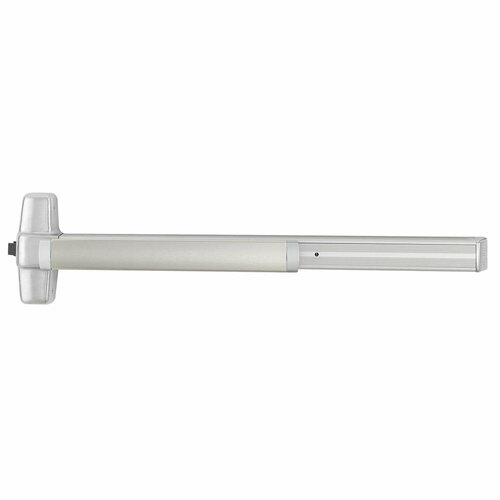
Sargent describes the 8800 as a "single point rim latching device" for single doors and for double doors with mullions. The standard strikes are surface mounted: the ED5200 roller strike in Corbin Russwin's catalog and Sargent's 649 strike. For a pair of doors, Corbin Russwin's catalog defines the mullion as "a fixed or removable vertical member that divides a door opening and provides a latch surface for a pair of rim exit devices."
Surface vertical rod (SVR) exit devices
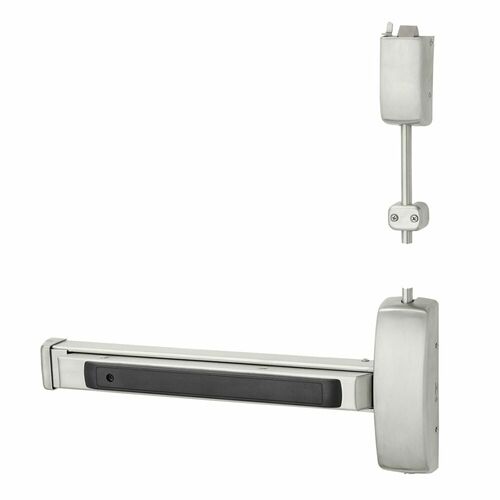
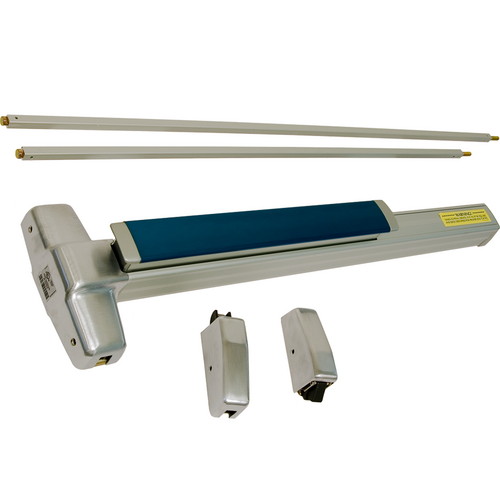
Sargent lists "two point latching (top & bottom ...)" for the 8700, for single and double doors, with a top strike surface applied to the frame and a bottom strike applied to the floor or to a flat threshold.
Concealed vertical rod (CVR) exit devices
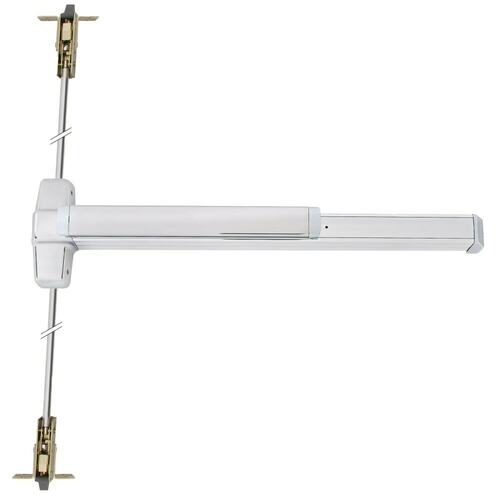
A CVR device also latches at the top and bottom, but its rods are concealed. Sargent lists "concealed rods for security and aesthetics" for the MD8600, with a top strike for hollow metal frames and a bottom strike mortised into the floor. The catalogs name the door construction for their CVR models:
- Sargent: MD8600 for metal doors, AD8600 for aluminum doors, WD8600 for wood doors.
- Von Duprin: separate wood door versions, 9847 WDC and 9947 WDC.
- Corbin Russwin: the ED4800 and ED5800 are marked "for use with metal doors only", the ED5860 "for use with metal or wood doors".
Corbin Russwin ED4800 installation instructions (PDF, 10 pages, 12/09 edition).
Mortise exit devices
A mortise exit device works with a mortise lock installed in the door. In Von Duprin's 98/9975 mortise exit device installation instructions (PDF, 9 pages, an older fax edition), the 7500 mortise lock is installed into the door and the supplied strike is installed on the frame or the other door: 575 for a single door, 575/575-2 or 576A/576B for a pair. Sargent describes the 8900 as "concealed single point guarded latching" for single doors and for double doors with a vertical rod device.
Less bottom rod (LBR) vertical rod devices
All three brands list some vertical rod devices without the bottom rod:
- Von Duprin lists LBR (less bottom rod) among its rod options "for surface/concealed vertical devices only"; the 98/99 options page shows it for the 98/9927, 98/9947 and 98/9947WDC.
- Sargent says the 8700 "can not be used less bottom rod" and points to the NB8700, described as "single point top latching" with no bottom strike. The MD8600, AD8600 and WD8600 pages say "Specify NB- for less bottom rod".
- Corbin Russwin's ED5000 Quick Codes list M55, less bottom vertical rod, for the ED5470(B) surface and ED5860(B) concealed vertical rod devices only.
Exit device trim and dogging
Corbin Russwin's catalog defines trim as the "lever, pull, or thumbpiece used on the outside of an exit device door to control access to an area", and dummy trim as "trim only", usually on the inactive door of a pair. Von Duprin's 98/99 function codes include EO (exit only), DT (dummy trim), NL (night latch, key retracts), L (lever) and TP (thumbpiece), so a 99EO is a 99 rim device, exit only.
Corbin Russwin's ED4800 instructions describe dogging as a "feature to hold bolts retracted and touchpad depressed, for push-pull door operation." Von Duprin's 98/99 dogging options include HD (hex dogging), CD (cylinder dogging, panic only) and LD (less dogging).
What to specify when you order
- Device length: Von Duprin's 98/99 overview lists a 3 ft device for doors 2 ft 4 in to 3 ft wide and a 4 ft device for 2 ft 10 in to 4 ft. Sargent uses rails E (24 to 32 inch doors), F (33 to 36), J (37 to 42) and G (43 to 48). Corbin Russwin's standard 36 inch bar fits 30 to 36 inch doors, and W048 is a 48 inch bar for 36 to 48 inch doors.
- Door height: Sargent's 8700, NB8700 and MD8600 pages say the door height "must be specified". Von Duprin's price book assumes a 7'0" door for vertical rod devices unless another height is specified.
- Hand: Von Duprin devices are "furnished RHR when handing is not specified". Corbin Russwin lists its ED5200 rim device as non-handed and its ED5400 and ED5800 as "handed but easily field reversible". Hand codes such as RHR and LHR are explained in our door handing chart.
Exit devices at The Builders Supply
- Exit devices and panic hardware
- By type: rim, surface vertical rod, concealed vertical rod, mortise
- Exit device trim and exit device parts and mullions
- Examples: Von Duprin 99EO rim, Von Duprin 9927EO SVR, Sargent NB8710E SVR (less bottom rod), Von Duprin 9947EO CVR, Von Duprin 9975EO mortise, Sargent 8910G mortise
- Brands: Von Duprin, Sargent, Corbin Russwin
Not sure which type fits your opening? Our customer support team is available Monday - Friday, 8 AM - 4 PM Central Time, at 1-888-800-7789 or [email protected].
Related Products