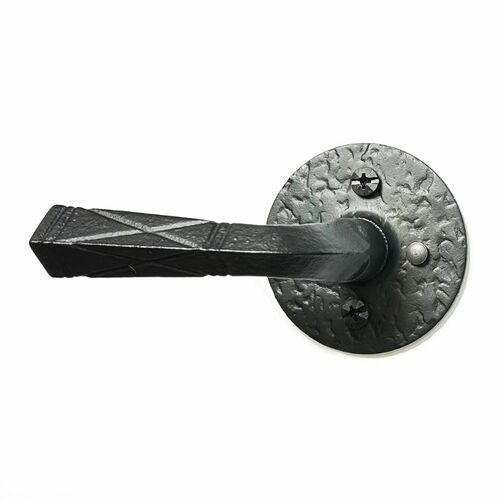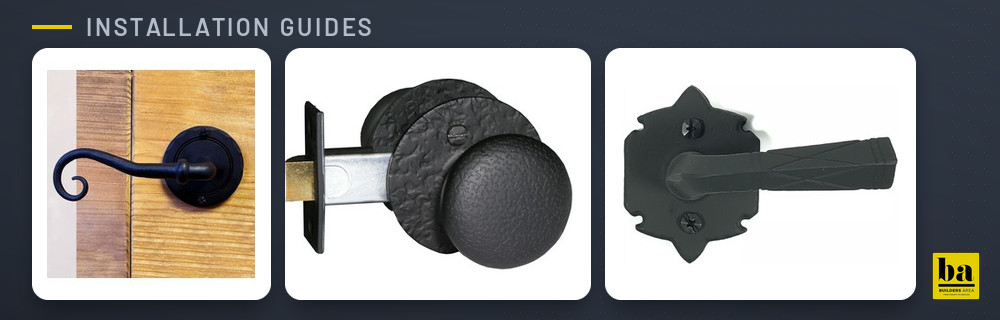
You have a door, maybe already bored for an ordinary knob, and a black Acorn set in mind. Whether the set fits comes down to three questions: is the door already drilled, what backset does the set have, and how thick is the door? Acorn answers all three, and its instruction sheets show how the door is prepared.
Terms such as mortise lock, tubular latch, backset and cross bore are explained in our guides to door lock types and door prep.
Will an Acorn mortise lock set fit a pre-drilled door?
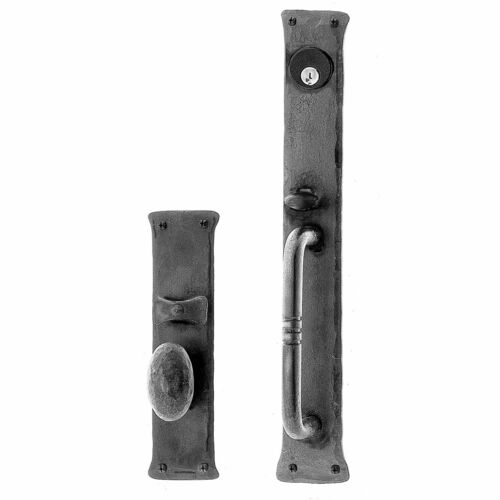
Not by Acorn's own description. The pages of the ATZBI forged bean, ATWBI forged double heart, RT2BI heart and IUBBI Greenwich handle and knob sets and the IW4BI Oregon double knob set each say the set is not for use with pre-drilled doors. The TMABG handle and knob lock, which Acorn includes in its handle and knob lock sets, carries the same warning.
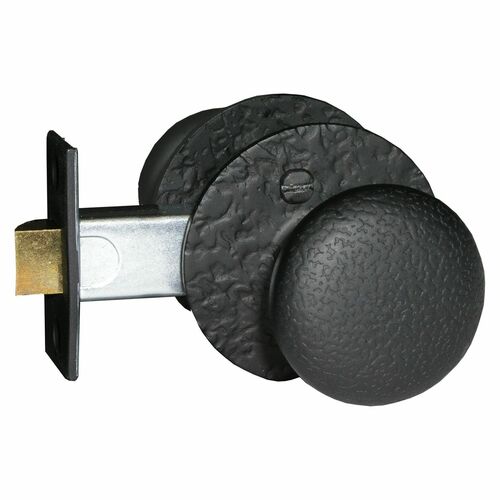
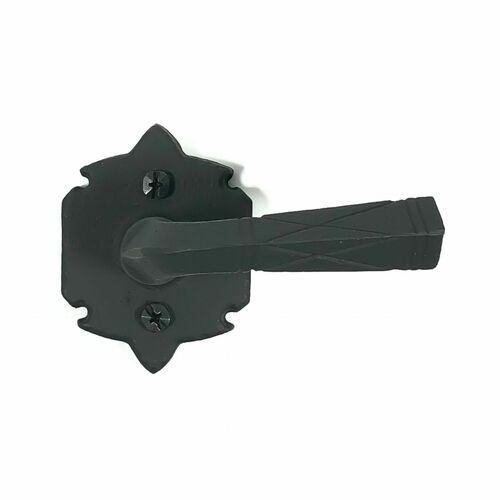
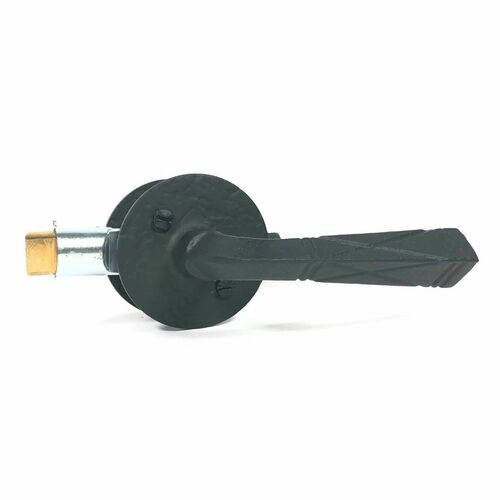
A door that is already bored points to Acorn's passage and privacy sets. On its build-your-own passage and privacy set page, Acorn says only the round rose and the large Warwick rose suit pre-drilled doors. Acorn lists the RZ3BI lever set on a round rose as suitable for pre-drilled doors, and the RURBI lever set on a large Warwick rose and the IWEBI scroll lever set for pre-drilled or undrilled doors. All three come with a tubular latch. For the RZ4BI privacy set, Acorn gives the bores as well: a 2-1/8" cross bore and a 1" edge bore at a 2-3/8" backset.
Backset and door thickness, set by set
On a door that is already bored, the backset of the set has to match the existing bore. Acorn's item pages give these figures:
| Acorn set | Backset | Door thickness |
|---|---|---|
| The five mortise sets above | 2-1/2" | 1-3/4" (standard set) |
| RZ3BI passage, RZ4BI privacy | 2-3/8" | 1-3/8" to 1-3/4" |
| RURBI passage | 2-3/8" | 1-3/8" to 1-3/4" |
| IWEBI passage | 2-3/8" | 1-3/8" to 1-3/4" |
Two of these passage sets also come with a 2-3/4" backset under a different number: RS3BI is the 2-3/4" version of the RZ3BI, and RSRBI of the RURBI. Acorn notes on the RZ3BI, RZ4BI and RURBI pages that these latch sets are not designed for heavy doors.
Preparing a door for a mortise lock set: Templates A and B
Acorn prints the installation steps on the ATZBI and ATWBI pages and puts both templates on sheet INS73. The tools it lists are a pencil, an awl, boring bits of 1/16", 3/4", 1" and 1-3/8", a wood chisel, a 1/8" Allen wrench and Phillips and straight screwdrivers. Settle the hand of the door first: Acorn reads it standing outside, and our door handing chart shows the four hands.
- Template A goes on the door edge, centered on the door thickness, about 36" from the floor to the bottom edge of the face plate or at another height you choose. Seven 1" holes are drilled 2-3/4" deep and the wood between them is chiseled out. A small extra mortise, 1/8" wide, 1/2" high and 7/8" deep, goes on the left or right side of the pocket depending on the hand. Then the face plate is traced and let in flush with the edge.
- Template B goes on the door faces, folded along line A or line B depending on the side the lock is on. On the outside it marks hole 1 (1-3/8") and hole 2 (3/4"), which takes the thumb piece of the handle. On the inside it marks holes 3 and 4 (3/4"), for the thumb turn and the spindle. Acorn's text says not to drill these holes beyond the mortise pocket.
- Sheet INS26 shows the two-part spindle: spindle A goes through the hub of the lock with its threads down, and spindle B slides on top of it, threads up, until the ends line up.
The cylinder in all five sets uses a Schlage C keyway, according to their pages. Our key blank chart lists the C keyway blanks. The same pages name matching dummy sets (ATZBD, ATWBD, RT2BD, IUBBD, IW4BD), and some designs have left and right hand dummy sets.
Passage and privacy sets: new bore or existing bore
Acorn's passage latch sheet INS92 and privacy latch sheet INS91 start from a door with no holes; Acorn links both from its build-your-own passage and privacy set page. You choose the backset, 2-3/8" or 2-3/4", and fold the template enclosed with the set over the door edge at the height you want, with the fold on the low side if the door is beveled. Then:
- Edge bore: a 1" hole, 3-1/2" deep for a 2-3/8" backset or 3-7/8" deep for a 2-3/4" backset.
- Face bore: drilled through with a 5/8" to 1" bit. On wood doors Acorn suggests a centering hole through the door first, then the face bore from both sides.
- Face plate: the outline is traced, the 1/8" screw holes are drilled and the mortise is chiseled 5/32" deep.
- Privacy latch only: a plastic spacer is fitted on the latch.
- Strike: marked on the jamb with the strike template, drilled and mortised.
For a door that is already drilled, side 2 of INS92 says to start at step 10, and side 2 of INS91 at step 11. Those steps put the spindle through the latch, fit the roses, drill their screw holes and tighten the knob or lever set screws onto a flat side of the spindle with a 1/8" Allen wrench. On the privacy set the locking button goes in last, from the inside.
Acorn describes its privacy function as a button on the rose and includes an emergency entry key with its privacy sets. It also notes that the rectangular rose and the Warwick rose are not large enough for privacy. Our lock functions guide explains passage and privacy in more detail.
What the sets are made of
Every set in the table above is finished in matte black, but Acorn names the material item by item. The five mortise sets are made from forged steel. The RURBI lever set is cast iron. On the build-your-own passage and privacy sets the knobs are solid zamac and the levers cast iron, and the RZ3BI page describes its set as "Completed in Iron".
Acorn at The Builders Supply
Our Acorn brand page lists the Acorn hardware in our catalog, and below this guide you will find examples of both kinds of set.
Not sure which backset or door thickness you have? Our customer support team is available Monday - Friday, 8 AM - 4 PM Central Time, at 1-888-800-7789 or [email protected].
Related Products