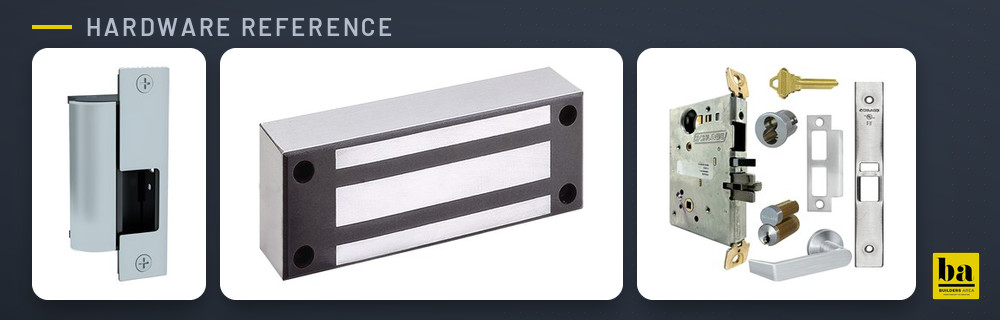
When you order an electrified lock, strike or exit device, the product name and specification are full of terms and codes, and some of them decide what the door does when the power goes off. The sections below cover these terms: fail safe and fail secure, codes such as EL and EU or FS and FSE, electric strikes, maglocks, electrified locks and exit devices, request to exit switches, power transfers and power supplies. The definitions come from manufacturer documents.
Fail safe vs fail secure
The terms say what a device does with its power off. Von Duprin's 98/99 Series catalog defines them for its electric mortise lock device: fail safe means locked when energized and unlocked when de-energized or during a power failure. Fail secure means unlocked when energized and locked when de-energized or during a power failure. Schlage's L Series and ND-Series service manuals define EL (fail safe) and EU (fail secure) the same way: in the event of power failure, the opening will be unlocked with EL and locked with EU.
How the documents mark the fail mode:
| Maker, series | Fail safe | Fail secure |
|---|---|---|
| Schlage L, ND | EL | EU |
| Von Duprin 98/99 | FS | FSE |
| Sargent 8200 | 8270, 8272 | 8271, 8273 |
| Sargent 80 ET trim | 73, 75 | 74, 76 |
| Corbin Russwin ML20900 | SAF | SEC |
| HES 1006 | F | No letter (standard) |
Some products can be switched later. Schlage's electrified L Series locks have a case-mounted switch that lets the customer select EL (fail safe) or EU (fail secure) operation, and the EL or EU ordered sets the default switch position. Sargent lists its 8200 electromechanical locks as field configurable to fail safe or fail secure, and Von Duprin's M996 trim is furnished fail safe, convertible to fail secure by dip switch. Von Duprin's electric mortise lock device (prefix E) is ordered FS or FSE. The catalog says it cannot be changed in the field.
Voltage is printed per product. The Schlage L and ND-Series manuals give 12 or 24V DC, DC power only, and Sargent's 8200 catalog asks you to specify 12VDC or 24VDC. HES's electric strike FAQ says "Confirm with a local authority having jurisdiction as to which function is required for a specific application." The manufacturer's instructions and the authority having jurisdiction decide.
Electric strikes
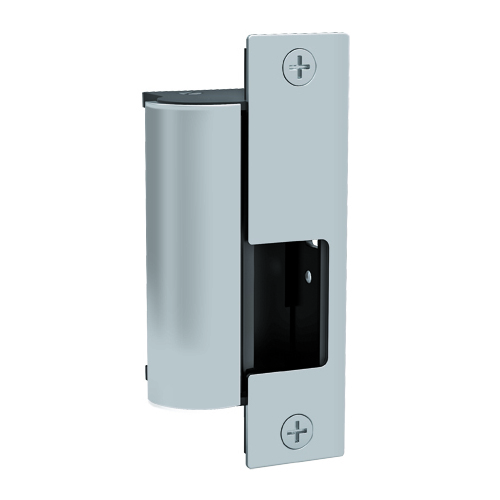
An electric strike mounts in or on the door frame (HES notes that a 1006 can also go into the inactive leaf of a pair of doors at least 1-3/4 inches thick) and works with the lock or exit device on the door. HES's Electric Strike Selector Guide starts with the frame material and says that the existing locking hardware determines the compatible electric strike and the overall function of the opening. See our HES strike faceplates and parts guide and HES 1006, 9600 and 5000 instructions guide.
Electromagnetic locks (mag locks)
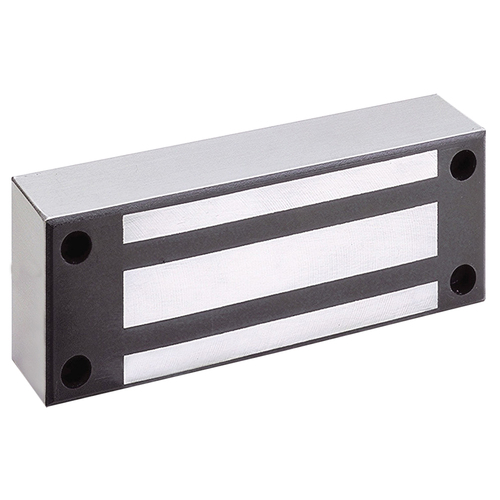
In Securitron's typical installation diagrams the Magnalock mounts on the door frame and its strike plate on the door. The instructions for the M32, M62 and M82 list holding forces of 600, 1200 and 1800 lbs and 12/24 volts DC operation. Securitron calls its M38 and M68 fail safe electromagnetic locks. Its maglock FAQ says that all maglocks are fail safe, which means they must unlock when power is completely removed. Options B (BondSTAT bond sensor) and D (door position switch) add monitoring to the M62.
Electrified mortise and cylindrical locks
What power changes, from the manufacturers' function lists:
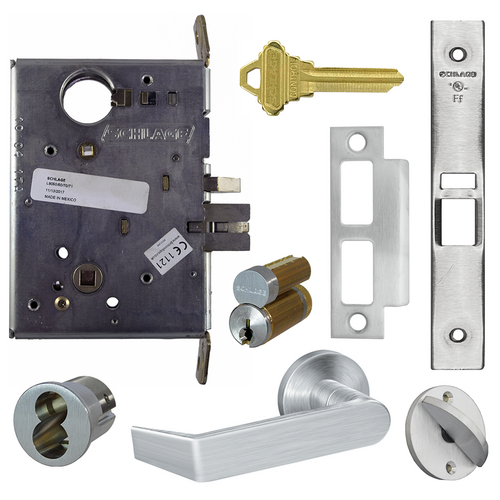
- Schlage L9092 EL/EU (mortise): while powered, the outside lever is continuously locked (EL mode) or unlocked (EU mode).
- Schlage ND80EU (cylindrical, storeroom): the lever is continuously locked until it is unlocked by the key outside or by electric current.
- Sargent 8270 and 8271 (mortise): with power on, the 8270 locks the outside lever and the 8271 unlocks it; both are available with Request to Exit (RX-) and other options.
- Corbin Russwin ML20900 and ML20600 NAC (mortise): ordered SAF or SEC; see our ML2000 instructions guide.
Electrified exit devices and panic hardware
Two electrified options for exit devices (see our exit device types guide) appear in both the Von Duprin and Sargent catalogs:
- Electric latch retraction. Von Duprin's QEL (quiet electric latch retraction) can also be activated by an access system or building automation system to unlatch the exit device momentarily. The catalog adds that QEL devices "always provide mechanical egress" and lists its electrical load at 24VDC. Sargent's 56- option uses a latch retraction motor, and once the latch is retracted, the door functions in a push and pull manner.
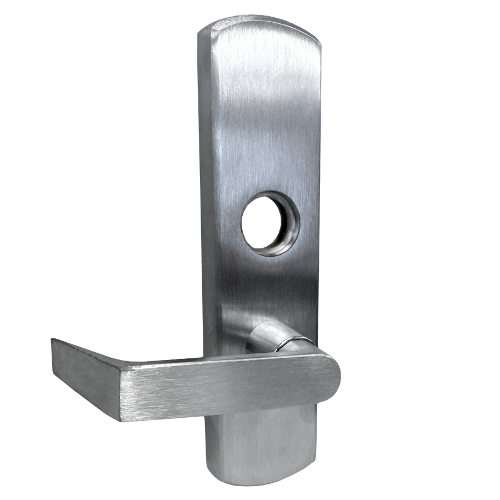
- Electrified trim. Von Duprin's M996L motor driven trim provides remote locking and unlocking, and Sargent's ET trim provides a remote means of locking and unlocking the lever.
Von Duprin's catalog also lists the Chexit delayed egress device among its electrified options (see our Chexit manual guide).
Request to exit and monitoring switches
Von Duprin's catalog says the RX feature is used to signal the use of an opening and that the RX switch should be used as a signaling switch, not to control a load. Schlage's L Series manual defines:
- Request to exit (RX): a microswitch detects rotation of the inside knob or lever and signals the use of the opening to the security system.
- Latchbolt monitor (LX): identifies the status of the latchbolt (extended or retracted).
- Door position switch (DPS): detects whether the door is open or closed, with a sensor in the lock and a magnet in the door strike.
Other codes: Sargent 80 Series 53- (latchbolt monitoring switch) and 55- (request to exit signal switch in the rail), HES 1006 LBM and LBSM latchbolt monitors, Corbin Russwin M92 (request to exit monitor).
Power transfers and power supplies
Von Duprin's catalog describes an electrical power transfer as a means of transferring electrical power from a door frame to the edge of a swinging door. It also notes that the QEL option does not include the power transfer from door to frame, the power supply or the control operator. For its 56- option, Sargent lists a standard electric hinge, with no special power transfer required. More in our Securitron EPT guide.
The PS900 Series power supplies in Von Duprin's catalog convert high voltage AC power into the regulated low voltage DC outputs required by most access control devices.
Electrified hardware at The Builders Supply
- Categories: Access Control & Electrified Hardware, Electric Strikes, Magnetic Locks, Electrified Mortise Locks, Electrified Cylindrical Locks, Electrified Exit Devices & Kits, Power Supplies & Wiring
- Strike and maglock: HES 1006F630 (F = fail safe), Securitron M62 Magnalock
- Electrified locks: Schlage L9092EU kit, Sargent RX-8271-12V, Schlage ND80PDEU storeroom lock
- Exit devices: Von Duprin QEL99EO rim device, Von Duprin M996L-RV trim
- Power supply: Schlage PS902-2RS
Questions about an electrified product code? Our customer support team is available Monday - Friday, 8 AM - 4 PM Central Time, at 1-888-800-7789 or [email protected].
Related Products